Best Fishing Spots Near South Padre Island in Winter
Most people think of South Padre Island as a summer destination. They are not wrong — the summer fishing is excellent. But the anglers who come back in December, January, and February know something the summer crowd does not: winter on the Lower Laguna Madre concentrates fish in ways that summer never does.
When the water cools, fish stop roaming. They stack. They hold in specific places for days at a time, feeding on predictable schedules. If you know where those places are, winter fishing is not harder than summer fishing — it is just different.
Winter Texans — the seasonal residents who come to the Rio Grande Valley every year from November through March — have known this for decades. Many of them fish the Laguna Madre every winter and consider it some of the best inshore fishing they do all year. If you are spending the winter in the Valley, a bay charter with Captain Kevin belongs on the list.
I have been running charters on South Padre Island for years. Here are the spots that consistently produce from December through February, and the reasoning behind why each one works.
Why Winter Changes Where the Fish Are
Before getting into specific locations, it helps to understand the mechanics. The Lower Laguna Madre is a shallow, hypersaline lagoon — most of it runs two to four feet deep. In summer, that shallow water warms quickly and fish spread across miles of grass flats. In winter, the same shallow water cools quickly, and fish abandon it.
Cold-blooded fish are metabolically tied to water temperature. When the Laguna Madre drops below 60°F, speckled trout become sluggish and seek thermal refuge in deeper water. Redfish are hardier but still prefer warmer water when they can find it. Black drum are the most cold-tolerant of the three and actually feed more aggressively in cold water than the other species.
The result is predictable winter geography: trout go deep, redfish go to the warmest shallow water they can find, and black drum move onto structure. Once you understand that, the map writes itself.
Deep Channels and Drop-Offs — Speckled Trout
The most reliable winter trout spots on the Lower Laguna Madre are the deeper channels and pronounced drop-offs where water depth transitions from one to two feet on the flat to four to six feet in the channel.
The Intracoastal Waterway is the most obvious example. The ICW runs the length of the Laguna Madre and provides consistent depth in a system that is otherwise very shallow. In winter, trout stack along the channel edges — not necessarily in the deepest water, but on the transition zones where the flat meets the drop. A soft plastic on a 1/4 oz jig head worked slowly along the bottom of that transition is one of the most consistent winter trout presentations on the bay.
Secondary channels and natural cuts that drain the interior flats into deeper water are equally productive and often less pressured than the ICW itself. These spots are harder to find without local knowledge, but they hold fish reliably through the coldest months.
What to look for: Depth transitions of two feet or more over a short horizontal distance. Baitfish — mullet, glass minnows — holding near the channel edge. Current moving through the cut on a tidal change.
Best conditions: Stable weather, light wind, water temperature between 55°F and 65°F. The bite improves significantly on the second and third day after a cold front passes, once the water begins to stabilize.
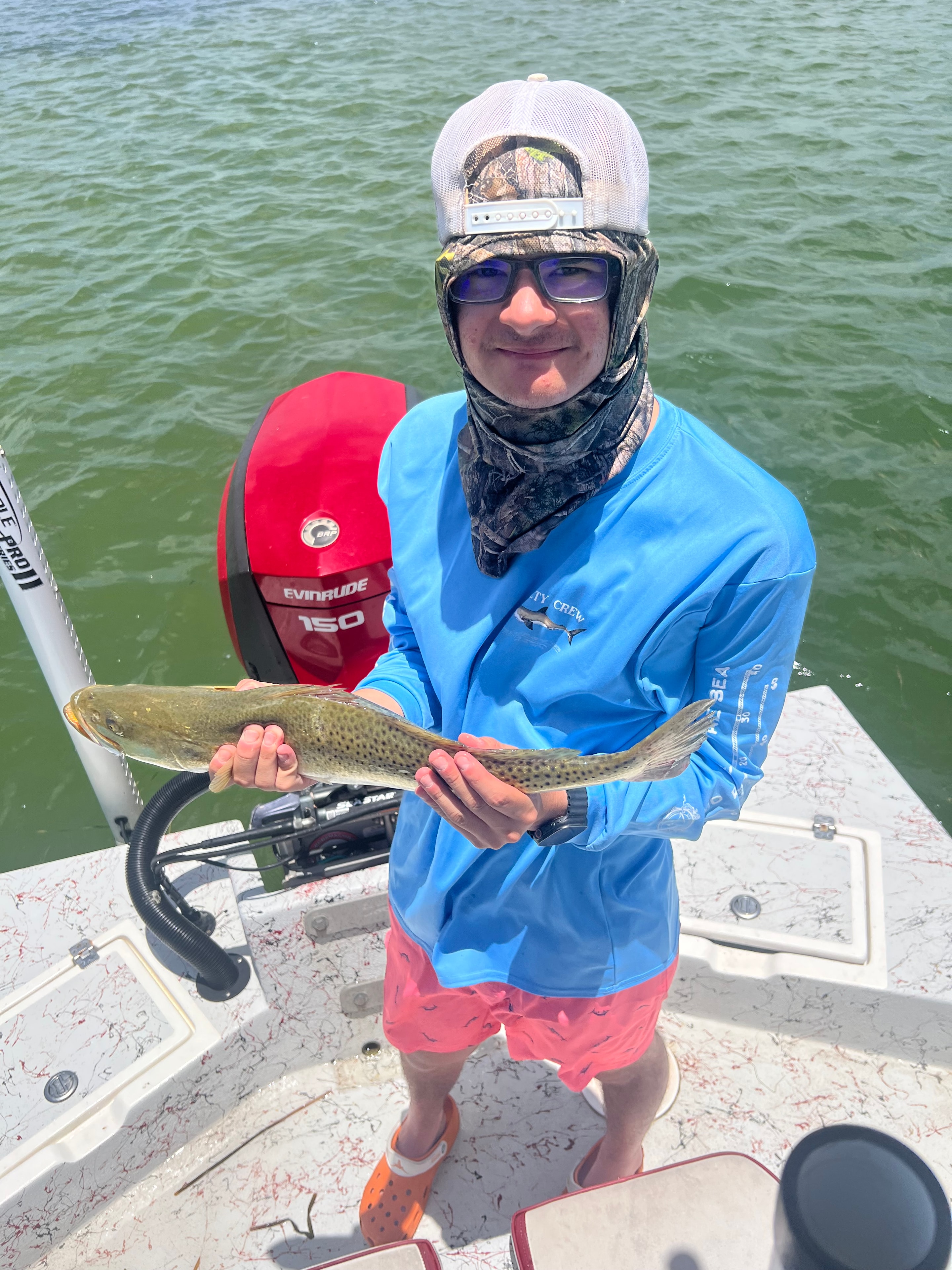
!Speckled trout caught on the Laguna Madre in winter
*A solid speckled trout from the Laguna Madre. Winter fish like this one hold tight to channel edges and drop-offs — they do not roam the way they do in summer.*
Sun-Warmed Mud Flats — Redfish
Redfish in winter are solar-powered. On a clear, calm day, the sun heats shallow mud flats faster than deeper water, and redfish move onto those flats to warm up and feed. The best redfish spots in winter are the shallowest, darkest-bottomed flats on the south end of the Laguna Madre — areas where a foot or less of water sits over dark mud that absorbs heat quickly.
These flats are often visible from the boat as a color change — darker bottom against the lighter sand. On a cold morning, they may be empty. By 10 or 11 AM on a sunny day, they can be loaded with redfish tailing and pushing wakes in six inches of water.
The timing matters. Winter redfish on mud flats are a mid-morning to early afternoon bite. The water needs time to warm. Fishing the same flat at 7 AM that was full of fish at noon the day before is a common mistake.
What to look for: Dark mud bottom in one to two feet of water. South-facing exposure that catches maximum sun. Proximity to deeper water where fish can retreat when temperatures drop at night.
Best conditions: Clear sky, light or no wind, air temperature above 50°F by mid-morning. Two or more days of stable weather after a front. Wind from the south or southeast, which pushes warmer water onto the flats.
Presentation: Weedless soft plastics or a gold spoon worked slowly across the flat. In very shallow water, a weedless rigged paddle tail with no weight lets you cover the flat without spooking fish. Sight-fishing is possible on calm days — polarized sunglasses are essential.
Oyster Reefs and Shell Pads — Black Drum
Black drum are the most underrated winter target on the Laguna Madre. They are large — fish in the 10 to 30 pound range are common — they fight hard, and they feed actively in cold water that slows down trout and redfish. The key is finding the right structure.
Oyster reefs and shell pads scattered across the interior of the Laguna Madre are the primary winter black drum habitat. These reefs hold the crabs, clams, and shellfish that black drum feed on, and the hard bottom provides thermal stability compared to the surrounding soft mud. Fish hold on these reefs through the coldest months and can be caught consistently with the right presentation.
The best reefs are the ones that are not obvious from the surface — submerged shell pads in two to four feet of water that do not break the surface at normal tide. Visible reefs get pressure. The productive ones require local knowledge or a good chart and some exploration.
What to look for: Hard bottom in two to four feet of water. Crunching sound under the hull when you pole or drift over shell. Mullet and sheepshead working the same structure — both are indicators of productive reef.
Best conditions: Black drum are the least weather-sensitive of the three winter species. They feed before, during, and after cold fronts. A slow drift over a productive reef with fresh blue crab or shrimp on the bottom is effective in almost any winter conditions.
Presentation: Fresh blue crab cut in half, fished on the bottom with a fish-finder rig. Fresh shrimp is a reliable backup. No weight is needed in shallow water — just enough to keep the bait on the bottom. Black drum are not fast strikers; give them time to pick up the bait before setting the hook.
The Warm-Water Discharge Areas
One location worth mentioning specifically: the warm-water discharge areas near the power generation facilities on the Laguna Madre. These spots maintain artificially elevated water temperatures year-round and attract fish in winter the way a heated pool attracts people in January.
Trout, redfish, and black drum all congregate near these areas when the surrounding bay water gets cold. The fishing can be exceptional on the coldest days of the year — days when the rest of the bay is largely shut down. These spots are well-known and can be crowded on weekends, but on a weekday in January they are worth the trip.
Passes and Nearshore Structure
The Land Cut — the man-made channel connecting the Laguna Madre to the Corpus Christi Bay system to the north — is worth mentioning as a winter trout location. The deeper water and consistent current flow make it a reliable cold-weather holding area for large speckled trout. Fish the channel edges and any points or bends where current deflects.
The jetties at the Brazos Santiago Pass hold fish year-round, but winter brings a different mix. Sheepshead are abundant on the rocks from December through February and are excellent table fare. Redfish hold in the wash along the base of the rocks. An occasional large speckled trout works the deeper water near the pass mouth.
Timing Your Winter Trip
The single most important variable in winter fishing on the Laguna Madre is cold front timing. The pattern repeats throughout the season:
- **Pre-front (24–48 hours before):** Excellent bite as pressure drops and fish feed aggressively
- **During and immediately after the front:** Slow to dead — wind, cold water, and pressure change shut the bite down
- **Three to seven days post-front:** The best window — water stabilizes, temperatures begin recovering, fish resume feeding on a predictable schedule
If you have flexibility in your travel dates, plan to arrive three to four days after a front passes. That window consistently produces the best winter fishing on the Laguna Madre.
Water temperature is the other key variable. The Laguna Madre rarely freezes, but water temperatures below 50°F make for very slow fishing across all species. The sweet spot for winter fishing is 55°F to 68°F — cold enough that fish are concentrated, warm enough that they are still actively feeding.
What to Bring
All rods, reels, tackle, and bait are provided on every charter — you do not need to bring fishing gear. For winter trips, the practical considerations are about comfort on the water:
- **Layers:** South Texas mornings can be cold, especially with wind chill on the water. A base layer, fleece mid-layer, and windproof shell covers most winter days. By midday it often warms into the 60s or low 70s.
- **Polarized sunglasses:** Essential for sight-fishing redfish on mud flats and reading water color and bottom type.
- **Sun protection:** Winter sun on the water is still strong, especially on calm days with glare off the surface.
No fishing license is required — Captain Kevin's Texas Registered Guide license covers all guests on the charter.
Book a Winter Charter
Winter on the Lower Laguna Madre is one of the most rewarding times to fish South Padre Island. The crowds are gone, the fish are concentrated, and the days are comfortable once the sun gets up. If you know where to look — and now you do — December through February is as good as any month on the bay.
Winter Texans who spend the season in the Rio Grande Valley have a standing invitation: the Laguna Madre is right here, the fish are stacked, and a six-hour bay charter with Captain Kevin is one of the best ways to spend a winter morning in South Texas.
Book a winter charter with Captain Kevin and put this knowledge to work on the water.
Ready to book your South Padre Island charter?
Spots fill fast — especially on weekends and holidays. Secure your date with Captain Kevin today.
Licensed USCG Captain · Private Bay Charters · South Padre Island, TX