Trophy Redfish at South Padre Island — Bull Reds, Oversized Fish, and How to Catch Them
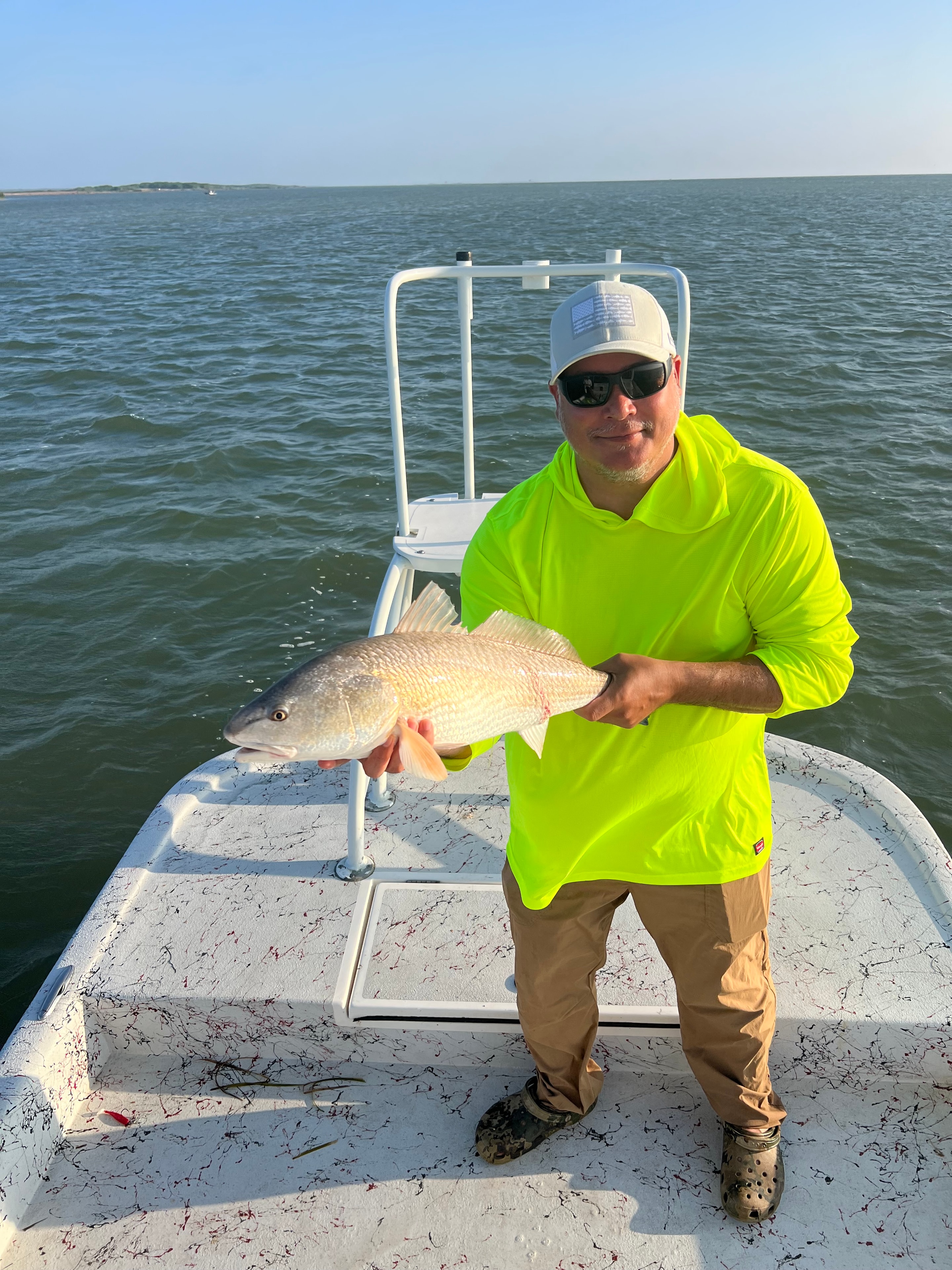
Most anglers who fish the Laguna Madre are targeting slot redfish — the 20–28 inch fish that are legal to keep and make excellent table fare. They are a great target, and the Laguna Madre produces them in excellent numbers.
But there is another class of redfish in this bay that most visitors never specifically target: the bulls. Oversized redfish — fish over 28 inches, often pushing 30–40 inches and 20–40 pounds — live in the Laguna Madre year-round. They are not rare. They are not impossible to catch. They are simply a different fish that requires a different approach.
This guide covers everything you need to know about targeting trophy redfish at South Padre Island: what qualifies as a trophy, where the big fish hold, the best times of year to target them, the tackle that handles them, and the tactics that consistently produce oversized fish on the Lower Laguna Madre.
What Qualifies as a Trophy Redfish?
In Texas, the legal slot limit for redfish is 20–28 inches. One fish over 28 inches may be kept per person per day as an oversized trophy. Everything over 28 inches is, by definition, a trophy under Texas law.
But among serious inshore anglers, the threshold for a true trophy is typically higher. Fish in the 30–34 inch range are considered quality trophies. Fish over 34 inches — which can weigh 15–25 pounds — are exceptional. And the true bulls of the Laguna Madre, fish in the 36–40 inch range pushing 30–40 pounds, are the fish that anglers travel specifically to catch.
For context: a 40-inch redfish in 18 inches of water on light inshore tackle is a different experience than anything most anglers have encountered. These fish do not just run — they bulldoze. They use their size and the shallow water to their advantage in ways that will test your drag, your knots, and your patience.
The Biology of Bull Redfish
Understanding why big redfish behave differently from slot fish helps you find and catch them.
Redfish grow throughout their lives. A 5-year-old fish might be 22 inches. A 10-year-old fish might be 28 inches. The true bulls — fish over 30 inches — are typically 15–30 years old. They have survived everything the Laguna Madre has thrown at them for decades, which makes them more cautious, more experienced, and harder to fool than younger fish.
Bull redfish are also different in their behavior. Younger slot fish are often found in schools, moving across the flats in groups. Older bulls tend to be more solitary or travel in smaller groups of 2–5 fish. They hold in slightly different areas — deeper water near structure, channel edges, and the mouths of passes — and they feed differently, relying more on ambush and less on active pursuit.
The distinctive black spot near the tail that gives redfish their name is present on all fish, but bulls often have multiple spots — sometimes a dozen or more scattered across the tail section. This is a reliable visual indicator of an older, larger fish.
Where to Find Trophy Redfish on the Laguna Madre
Trophy redfish are present in the Laguna Madre year-round, but they concentrate in specific areas depending on the season.
Channel edges and drop-offs. The most reliable year-round holding area for big redfish is the transition between shallow flats and deeper water. Even a drop of 12–18 inches creates a current break and a temperature refuge that large fish use. Channel edges adjacent to grass beds are particularly productive — the grass holds baitfish, and the channel provides the depth that big fish prefer.
Pass mouths. The passes that connect the Laguna Madre to the Gulf of Mexico are major highways for large redfish. Fish moving in and out of the bay concentrate near pass mouths, and the current created by tidal flow through the passes attracts baitfish — and the bulls that feed on them. The area around the South Padre Island passes is consistently one of the best trophy redfish locations on the Texas coast.
Oyster reefs and hard bottom. Large redfish are structure-oriented. Oyster reefs, shell pads, and hard bottom areas hold big fish year-round. These areas create current breaks, concentrate baitfish, and provide the kind of stable environment that older, more cautious fish prefer. Work the down-current edges of oyster reefs — that is where the fish hold.
Deep grass flats. In the Laguna Madre, "deep" is relative — we are talking about 4–6 feet of water rather than the 2–3 foot average of the shallow flats. Deeper grass flats hold large redfish, particularly in summer when shallow water gets too warm and in winter when cold fronts push fish off the exposed flats.
Shoreline structure. Large redfish use shoreline structure — points, cuts, and irregularities in the shoreline — as ambush points. A point that creates a current seam is a classic big-fish location. Fish the tip of the point and the down-current side where baitfish stack.
Seasonal Windows for Trophy Redfish
While trophy redfish are catchable year-round, certain seasons consistently produce more big fish.
Fall (October–November): Peak Trophy Season
Fall is the best time of year to target trophy redfish on the Laguna Madre. Fish that have been feeding since spring are at their maximum weight and condition. The cooling water temperatures trigger aggressive feeding behavior, and large fish that spent the summer in deeper water move back onto the accessible flats.
October and November consistently produce the largest redfish of the year. Fish in the 28–34 inch range are common during this period, and true bulls over 36 inches are caught regularly. The combination of fish size, feeding aggression, and comfortable weather makes fall the premier trophy redfish season.
Winter (December–February): Bull Season
Winter brings a different class of redfish to the Laguna Madre. The big bulls — fish that have been in the bay for 20+ years — are most accessible in winter. They hold in predictable locations near structure and channel edges, and they feed actively between cold fronts.
Winter trophy fishing requires patience and flexibility. Cold fronts can shut down the bite for 24–48 hours, but the post-front window — when conditions stabilize and fish feed aggressively — is when the biggest fish of the year are caught. A 35-inch bull redfish on a calm January morning after a front passes is a legitimate possibility on the Laguna Madre.
For the full winter fishing breakdown, see our winter fishing guide for South Padre Island and the winter Texan fishing guide.
Spring (March–May): Active and Accessible
Spring brings large redfish back onto the flats as water temperatures rise. Fish that spent the winter near structure and channel edges move into shallower water and become more active. Spring trophy redfish are aggressive and willing to chase a lure — the combination of accessible locations and feeding aggression makes spring an excellent trophy season.
Summer (June–August): Early Morning Only
Summer trophy fishing is possible but requires early starts. Large redfish move to deeper, cooler water during the heat of the day. The first two hours after sunrise — before the sun heats the shallow flats — are the productive window. Early morning sight fishing for large tailing reds on the flats can be exceptional in summer, but the window is short.
Tackle for Trophy Redfish
Slot-sized redfish can be caught on light inshore tackle — a 7-foot medium spinning rod with 10 lb braid and a 20 lb fluorocarbon leader. Trophy redfish require a step up.
Rod. A medium-heavy spinning rod in the 7–7.5 foot range gives you the backbone to control a large fish in shallow water and the sensitivity to feel strikes on the bottom. Avoid rods that are too stiff — you need some flex to absorb the runs of a big fish without breaking the line.
Reel. A 3000–4000 size spinning reel with a smooth, reliable drag is essential. Trophy redfish make long, powerful runs. A drag that sticks or surges will cost you fish. Spool with 20–30 lb braided line.
Leader. 30–40 lb fluorocarbon leader, 24–36 inches. Big redfish are not particularly leader-shy, but they are strong enough to abrade lighter leader material against oyster reefs and shell pads. The heavier leader also gives you more control when the fish runs toward structure.
Hooks. For live bait, a 3/0–5/0 circle hook is the standard choice. Circle hooks are nearly self-setting — when the fish runs with the bait, the hook rotates and sets in the corner of the mouth. Do not jerk-set a circle hook; simply reel down and apply steady pressure. For artificial lures, a 4/0–5/0 wide-gap hook on a 3/8 oz jig head handles big fish reliably.
Tactics for Trophy Redfish
Slow down. Big redfish are not in a hurry. They have been in this bay for 20 years and they have seen every fast-moving lure that has ever been thrown at them. A slow, deliberate presentation — a soft plastic worked with long pauses on the bottom, a live crab drifted along a channel edge — is more effective than a fast retrieve.
Live bait. For trophy redfish specifically, live bait outperforms artificial lures. Live blue crab is the single most effective trophy redfish bait in the Laguna Madre. Large redfish eat crabs constantly — they are built for it, with a downturned mouth and hard, crushing teeth designed to break crab shells. A live crab on a circle hook, fished on the bottom near structure, is the most reliable way to target the biggest fish in the bay.
Live mullet is the second-best option. Large redfish eat mullet aggressively, and a live mullet on a circle hook fished near pass mouths and channel edges produces trophy fish consistently.
Sight fishing for bulls. In clear, shallow water, large redfish are visible before you cast. A 30-inch bull moving slowly across a flat is an unmistakable sight — a large, bronze shape pushing a wake in water that barely covers its back. Cast 4–6 feet ahead of the fish (further than you would for a slot fish — big fish are more easily spooked) and let the lure sink before beginning a slow retrieve.
Work structure methodically. Rather than covering water quickly, slow down and work structure thoroughly. A productive oyster reef might hold 3–4 large redfish in specific spots — the down-current edge, a particular depression in the shell, a spot where the reef meets a sandy pocket. Work the entire structure before moving on.
Fight tactics. When a trophy redfish runs, let it go. Do not try to stop a big fish on its first run — you will break the line or straighten the hook. Keep steady pressure, let the drag do its job, and wait for the fish to tire. When it stops running, reel down and recover line. Repeat. Big redfish in shallow water will make multiple runs before they are ready to land. Keep the rod tip up, maintain steady pressure, and be patient.
Catch and Release for Trophy Redfish
Texas allows one oversized redfish per person per day as a trophy. Most serious trophy redfish anglers practice catch and release on the big bulls — not because they are required to, but because a 30-year-old fish is worth more in the water than on the wall.
If you choose to release a trophy fish, handle it carefully. Keep the fish in the water as much as possible. Support the body horizontally — do not hold a large fish vertically by the jaw, which can damage internal organs. Take your photos quickly and release the fish headfirst into the current. A healthy trophy redfish will swim away strongly.
If you want a mount, consider a replica. Modern fiberglass replicas are indistinguishable from skin mounts and last indefinitely. You can release the fish and still have a permanent record of the catch.
Booking a Trophy Redfish Charter
Captain Kevin specifically targets trophy redfish on request. If you want to focus on big fish rather than numbers, let him know when you book — he will plan the trip around the locations and techniques most likely to produce oversized fish based on current conditions.
Charter pricing: $550 for 2 people, $100 per additional angler, maximum 4 guests. 6-hour trip. All equipment provided.
Contact Captain Kevin to book your trophy redfish charter.
Frequently Asked Questions
What is considered a trophy redfish at South Padre Island? Under Texas law, any redfish over 28 inches is an oversized trophy (one per person per day). Among serious anglers, fish over 30 inches are considered quality trophies, fish over 34 inches are exceptional, and bulls over 36 inches are the true targets of dedicated trophy fishing.
What is the best time of year to catch trophy redfish at South Padre Island? Fall (October–November) is the peak trophy season — fish are at maximum weight and feeding aggressively. Winter (December–February) produces the biggest bulls, particularly in the post-front windows when large fish feed actively near structure. Spring is also excellent as fish move back onto accessible flats.
What bait is best for trophy redfish in the Laguna Madre? Live blue crab is the single most effective trophy redfish bait. Large redfish are built to eat crabs and will commit to a live crab on a circle hook fished near structure. Live mullet is the second-best option. For artificial lures, large soft plastics on heavy jig heads worked slowly on the bottom are the most effective presentation.
How big do redfish get in the Laguna Madre? The Laguna Madre produces redfish over 40 inches and 30+ pounds. These fish are 20–30 years old and have been in the bay their entire lives. Fish in the 28–34 inch range are caught regularly on guided charters. True bulls over 36 inches are caught every season.
Should I keep or release a trophy redfish? Texas allows one oversized redfish per person per day. Most serious trophy anglers practice catch and release on the big bulls — a 30-year-old fish is a significant resource. If you want a permanent record, consider a fiberglass replica mount, which allows you to release the fish and still have a lasting trophy.
Ready to book your South Padre Island charter?
Spots fill fast — especially on weekends and holidays. Secure your date with Captain Kevin today.
Licensed USCG Captain · Private Bay Charters · South Padre Island, TX