South Padre Island Fish Species Guide — What You Can Catch in the Laguna Madre
The Laguna Madre behind South Padre Island is one of the most productive inshore fisheries in North America. Five target species — redfish, speckled trout, flounder, black drum, and snook — live in these waters year-round or seasonally, and each one offers a distinct experience on the rod.
This guide covers all five: when they are in the bay, how big they get, how to catch them, and whether they are worth keeping for the table. If you are planning a trip to South Padre Island and want to know what you might be fighting at the end of your line, this is your reference.
The Laguna Madre: Why This Bay Produces
Before diving into individual species, it helps to understand what makes the Laguna Madre exceptional.
The Lower Laguna Madre is a hypersaline lagoon — saltier than the Gulf of Mexico — that runs roughly 120 miles along the Texas coast between South Padre Island and the mainland. It averages just 2–4 feet deep across most of its fishable area, which means it warms quickly, holds heat, and supports dense populations of the crabs, shrimp, and baitfish that inshore species depend on.
The shallow, clear water also makes it one of the best sight-fishing destinations in the country. On calm mornings, you can watch redfish tailing on the flats, spot speckled trout holding over grass beds, and see flounder half-buried in sandy pockets — all before you make a cast.
Captain Kevin has fished this bay his entire life. The patterns described below are based on years of experience on the Lower Laguna Madre specifically, not generic Texas coast advice.
Redfish (Red Drum)
Season: Year-round
Best months: October–November (fall), March–May (spring)
Typical size: 18–28 inches, 3–8 lbs in the slot; bulls over 28 inches common
Texas slot limit: 20–28 inches, one oversized per person per day
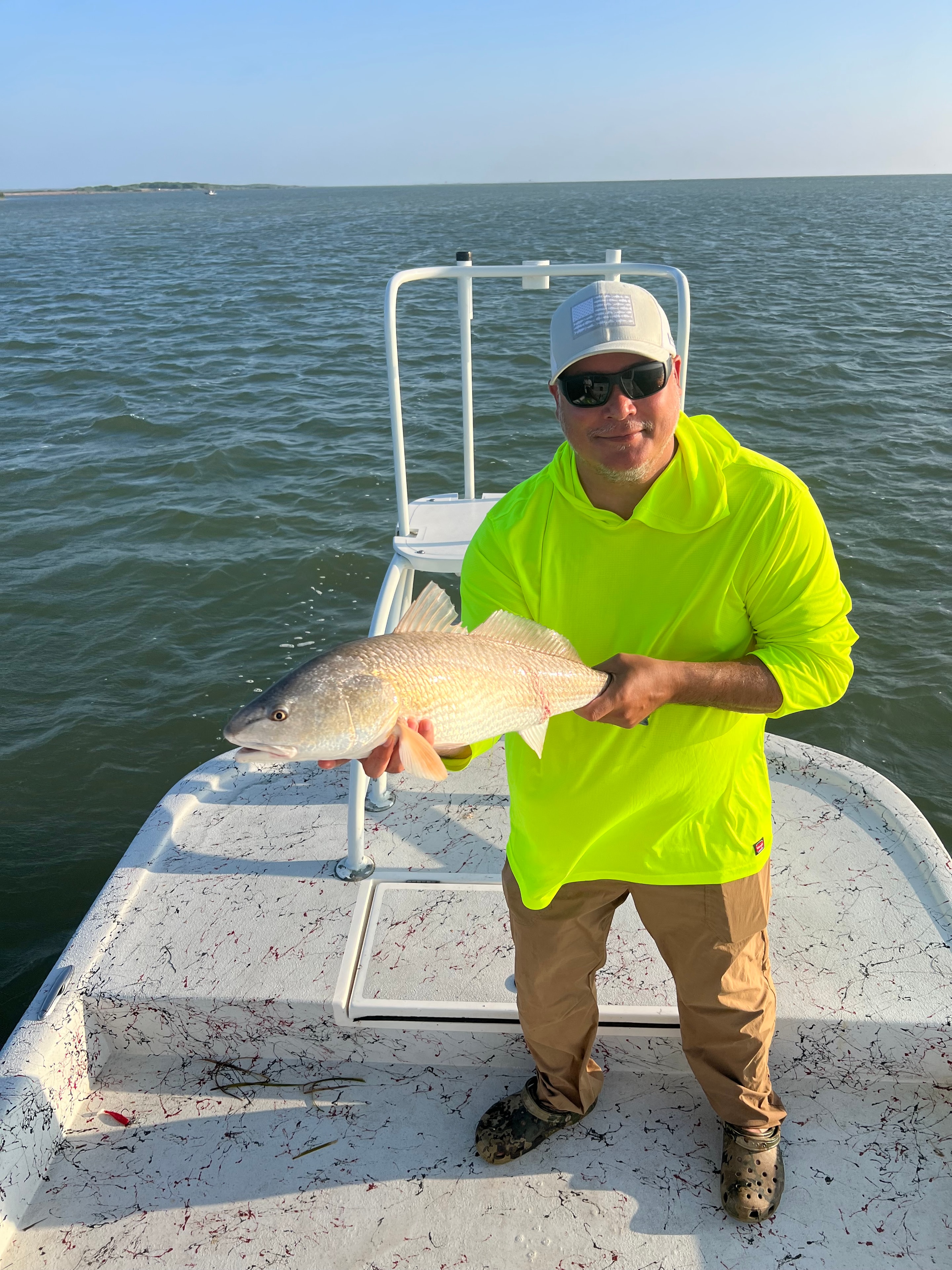
Redfish are the signature species of the Laguna Madre. Bronze-copper in color with a distinctive black spot near the tail, they are built for shallow water — rooting crabs and shrimp off the bottom with a downturned mouth, running hard when hooked, and fighting in a way that surprises most first-timers.
The Laguna Madre holds a resident redfish population that stays in the bay year-round. In fall, fish feed aggressively before winter and run large — 24–27 inch fish are common in October and November. In summer, early morning sight fishing for tailing reds on the flats is one of the most exciting experiences in inshore fishing anywhere.
How to catch them: Gold spoons, soft plastics on jig heads, and live shrimp under a popping cork are the three most reliable presentations. In clear water, sight casting to individual fish is the most rewarding approach. In murkier conditions, work structure edges and grass lines.
Table quality: Excellent. Firm, white meat with a mild flavor. Holds up well to blackening, grilling, or frying. A 24-inch red yields two solid fillets.
For a deep dive into redfish tactics, see our complete redfish fishing guide for South Padre Island.
Speckled Trout (Spotted Seatrout)
Season: Year-round
Best months: November–February (winter), March–April (spring)
Typical size: 14–22 inches, 1–4 lbs; trophy fish over 25 inches caught regularly
Texas limit: 5 fish per person per day, 15-inch minimum; one fish over 25 inches allowed
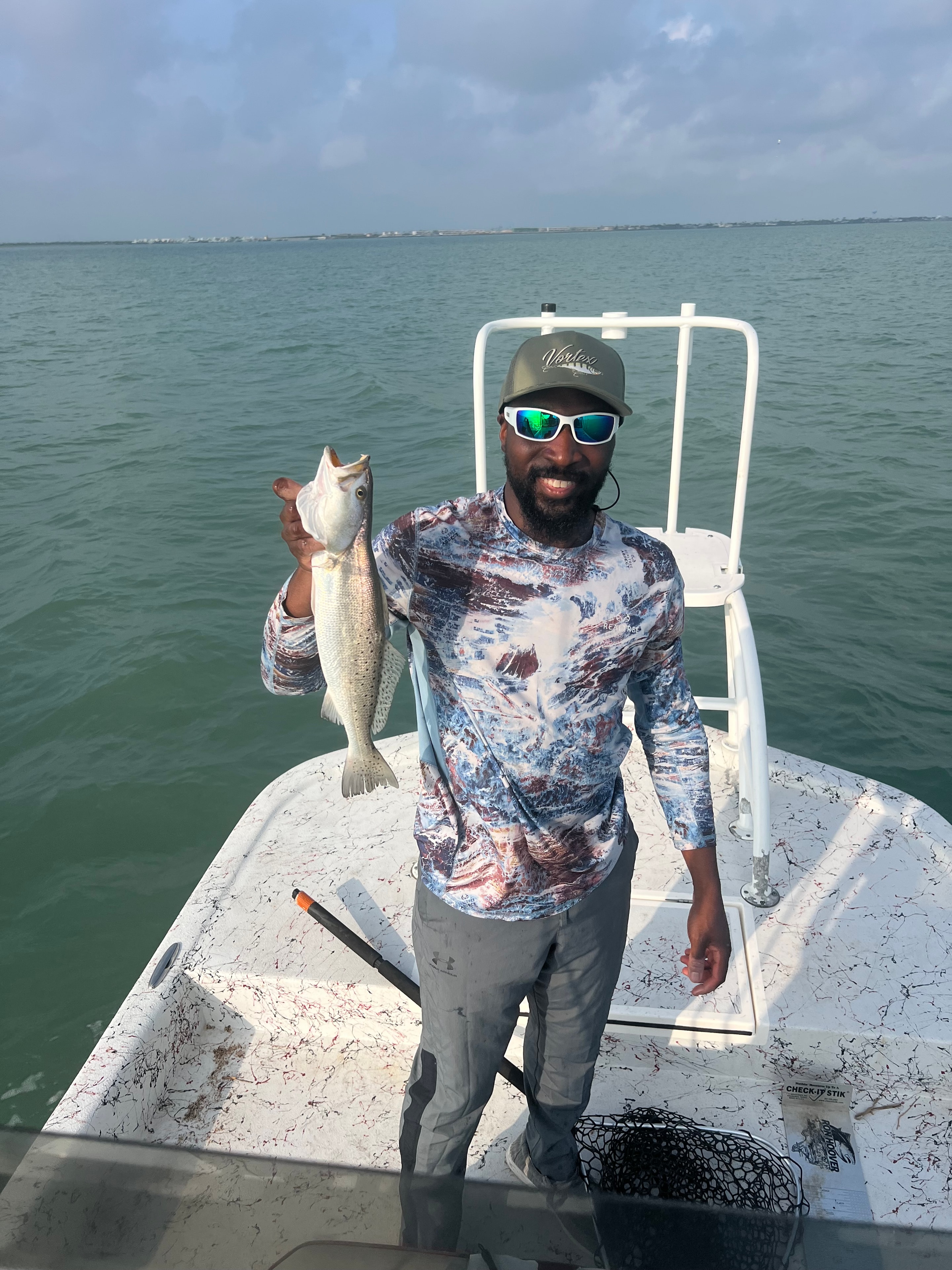
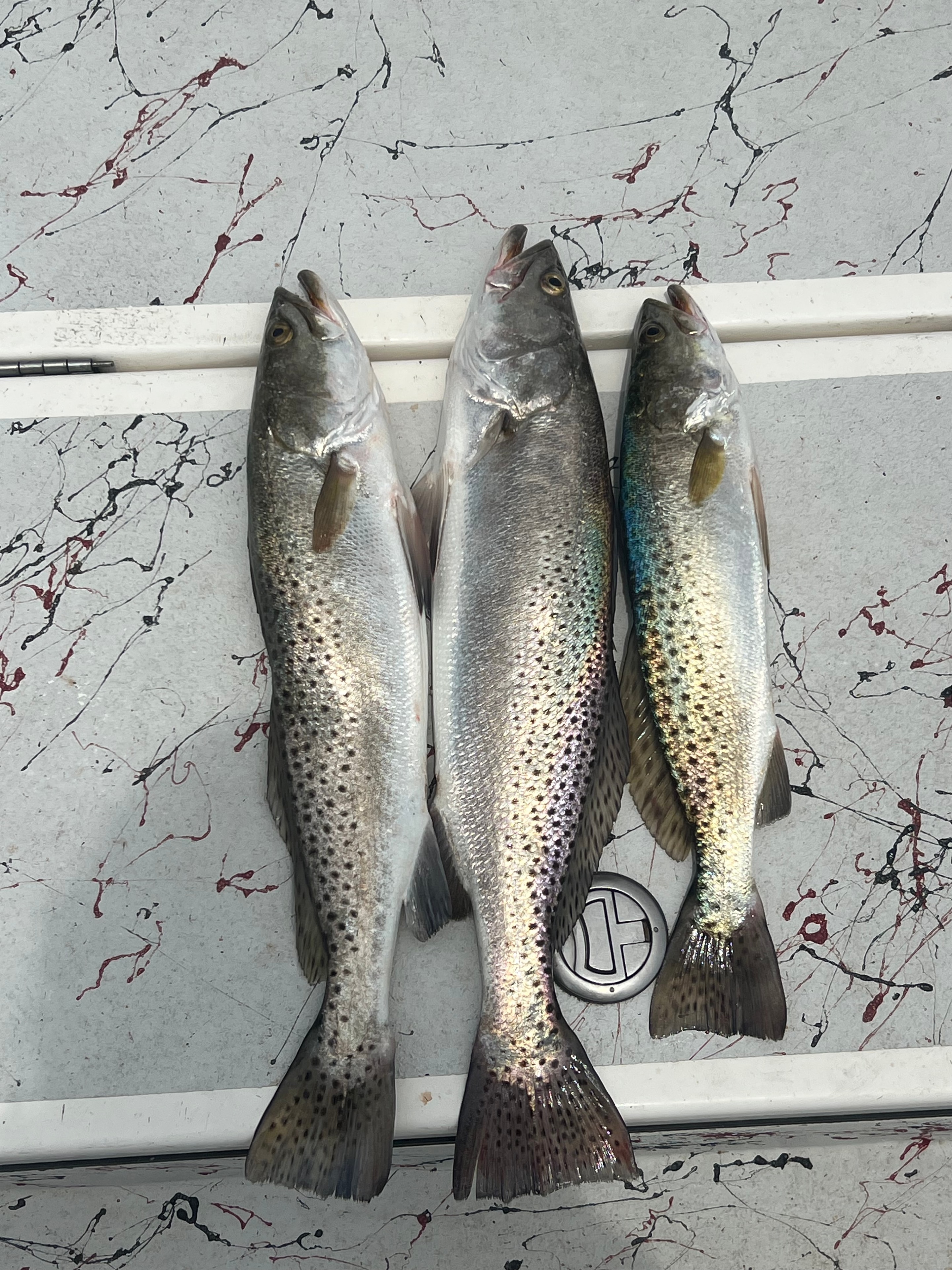
Speckled trout are the most sought-after species on the Texas coast, and the Laguna Madre produces them in excellent numbers. They are more finicky than redfish — more sensitive to water temperature, more selective about presentations — which makes them a satisfying target for anglers who want a challenge.
In winter, speckled trout move to slightly deeper water — channel edges, deeper grass flats, and protected coves — where temperatures are more stable. On warm winter afternoons, they move back onto the shallower flats and feed actively. The window between cold fronts is often the best time to target them.
In spring, trout spread across the flats as water temperatures rise. This is when you find them in the shallowest water of the year, and sight fishing for spring trout is exceptional.
How to catch them: Soft plastic paddle tails and shrimp imitations on light jig heads are the standard approach. Topwater lures — worked slowly in low-light conditions — produce explosive strikes and are a favorite among experienced anglers. Live shrimp is always effective. The key with trout is a slower, more subtle presentation than you would use for redfish.
Table quality: Outstanding. Speckled trout has delicate, white, flaky meat — considered by many Texas anglers to be the best-eating fish in the bay. Best prepared simply: pan-fried in butter or baked with lemon.
For the full seasonal breakdown, see our speckled trout fishing guide for the Laguna Madre.
Southern Flounder
Season: Year-round resident, but peak season is fall migration
Best months: Mid-October through mid-November
Typical size: 14–20 inches, 1–4 lbs; fish over 5 lbs caught during migration
Texas limit: 5 fish per person per day, 14-inch minimum
Flounder are ambush predators — flat, camouflaged fish that lie half-buried in sandy or muddy bottom waiting for prey to swim past. They are not the most glamorous fish to catch, but they fight surprisingly hard for their size, and they are arguably the best-eating fish in the entire bay.
The peak flounder season at South Padre Island is the fall migration. As water temperatures drop below 68–70°F in October, flounder begin moving from the bay toward the Gulf passes to spawn. This concentrates fish in predictable locations — channel edges, pass mouths, and sandy pockets near structure — and creates the best flounder fishing of the year.
Halloween week is often the single best week for flounder on the Laguna Madre. Fish are stacked in the passes, feeding aggressively before heading offshore, and limits are achievable for prepared anglers.
How to catch them: Flounder lie on the bottom and strike upward. A soft plastic on a jig head worked slowly along the bottom — with frequent pauses — is the most effective presentation. The strike is often subtle: a thump or a slight weight increase rather than a hard hit. Set the hook firmly and keep steady pressure.
Table quality: Exceptional. Flounder has white, mild, firm meat that many anglers consider the finest in the Gulf. Excellent fried, baked, or stuffed. A limit of flounder from the Laguna Madre will feed a family well.
For the complete fall flounder guide, see our flounder fishing post for South Padre Island.
Black Drum
Season: Year-round, but peak season is winter
Best months: December–February
Typical size: 14–30 inches for slot fish; bulls over 30 inches (20–40 lbs) common in winter
Texas limit: 5 fish per person per day, 14-inch minimum; one fish over 30 inches allowed
Black drum are the most underrated species in the Laguna Madre. They are big, powerful, and abundant in winter — exactly when most anglers are not thinking about fishing. A 30-pound black drum in shallow water is a serious fish that will test your tackle and your patience.
Black drum are bottom feeders, using sensitive barbels under their chin to locate crabs and mollusks. They are not as flashy as redfish or as finicky as trout, but they are reliable. In winter, when cold fronts push redfish and trout into unpredictable patterns, black drum often keep feeding steadily.
The largest black drum — the bulls — move into the Laguna Madre in December and January. These fish have been in the bay for decades and can exceed 40 pounds. Catching one on light inshore tackle is an experience that redefines what "fighting a fish" means.
How to catch them: Fresh or cut crab is the most effective bait for black drum. Shrimp works well for smaller fish. For lure fishing, a soft plastic worked slowly on the bottom near oyster reefs and shell pads produces consistent results. Black drum are not fast strikers — they pick up the bait and move slowly, so give them a moment before setting the hook.
Table quality: Good for smaller fish (under 15 inches). Larger black drum develop a stronger flavor and a coarser texture — most anglers practice catch-and-release on the big bulls. Fish in the 14–20 inch range are excellent table fare.
For the full winter black drum guide, see our black drum fishing post for South Padre Island.
Snook
Season: Summer and early fall
Best months: June–September
Typical size: 20–30 inches, 3–8 lbs; fish over 10 lbs caught occasionally
Texas limit: 1 fish per person per day, 24-inch minimum; closed season November 1 – April 30
Snook are the most exciting inshore species in the Laguna Madre — and the most challenging. They are aggressive, fast, and acrobatic. A hooked snook will run hard, jump repeatedly, and use every piece of structure in the area to cut your line. They are also the most temperature-sensitive species in the bay, which is why they are a summer target only.
Snook are a subtropical species that reached the Laguna Madre as water temperatures have warmed over recent decades. They are now a legitimate target species at South Padre Island from June through September, with peak action in July and August. They hold around structure — dock pilings, bridge supports, grass edges, and mangrove-like vegetation — and ambush prey in low-light conditions.
How to catch them: Live mullet, live shrimp, and large soft plastic swimbaits are the most effective presentations. Snook are structure-oriented — cast tight to cover and work the lure through the strike zone. Early morning and evening are the best times. Topwater lures at first light produce some of the most explosive strikes you will ever see in shallow water.
Table quality: Outstanding. Snook has white, firm, sweet meat — often compared to grouper. The closed season from November through April protects the population during cooler months when snook are most vulnerable.
For the complete snook guide, see our snook fishing post for South Padre Island.
Multi-Species Trips: What to Expect
One of the best things about fishing the Laguna Madre is that you rarely catch just one species. On a typical 6-hour charter, you might start the morning targeting redfish on the flats, pick up a few speckled trout along a grass edge, and find flounder stacked in a sandy pocket near a channel — all on the same trip.
Captain Kevin reads conditions and adjusts targets throughout the day. If the redfish are not cooperating, he moves to where the trout are. If the trout bite slows, he works structure for flounder or drum. The goal is to keep rods bent and guests engaged, not to stick rigidly to one plan.
The best time to fish South Padre Island guide breaks down which species are most active in each month, which is useful for planning a trip around a specific target.
Planning Your Trip
All five species described above are catchable on a standard 6-hour bay charter with Captain Kevin. The trip is $550 for 2 people, $100 per additional angler, maximum 4 guests. All rods, reels, tackle, bait, and equipment are provided. No fishing license required — Captain Kevin's Texas Registered Guide license covers all guests.
Contact us to book your South Padre Island fishing charter or call Captain Kevin directly to ask about current conditions and what is biting right now.
Frequently Asked Questions
What is the most common fish caught at South Padre Island?
Redfish are the most consistently caught species year-round. Speckled trout are a close second. In fall, flounder become the primary target during the migration. Black drum dominate winter trips, and snook are the summer specialty.
Can I catch multiple species on one charter trip?
Absolutely. Multi-species trips are the norm on the Laguna Madre. A typical 6-hour charter might produce redfish, speckled trout, and flounder on the same day, depending on the season and conditions.
Do I need a Texas fishing license for a guided charter?
No. Captain Kevin's Texas Registered Guide license covers all guests on the charter. You do not need to purchase a separate state fishing license.
What is the biggest fish I can expect to catch?
Black drum bulls in the 20–40 pound range are the largest fish regularly caught in the Laguna Madre. Oversized redfish (over 28 inches) and large speckled trout (over 25 inches) are also caught regularly. Snook over 10 pounds are possible in summer.
Are the fish good to eat?
All five species are excellent table fare in the right size range. Flounder and speckled trout are considered the finest eating fish in the bay. Redfish is excellent blackened or grilled. Black drum is best in the smaller sizes. Snook is outstanding but has a closed season from November through April.
Ready to book your trip?
Text Captain Kevin: 956-433-7287